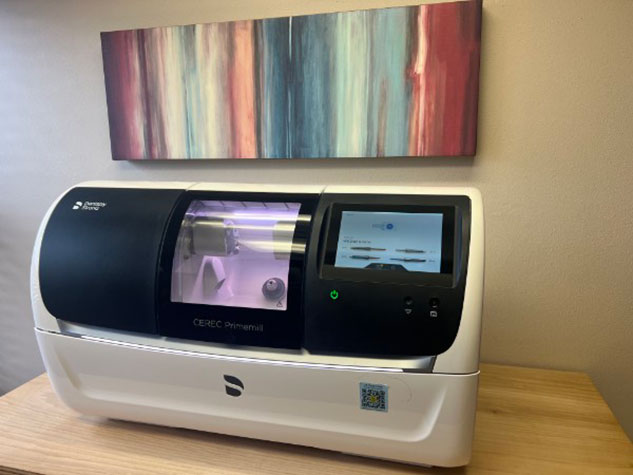
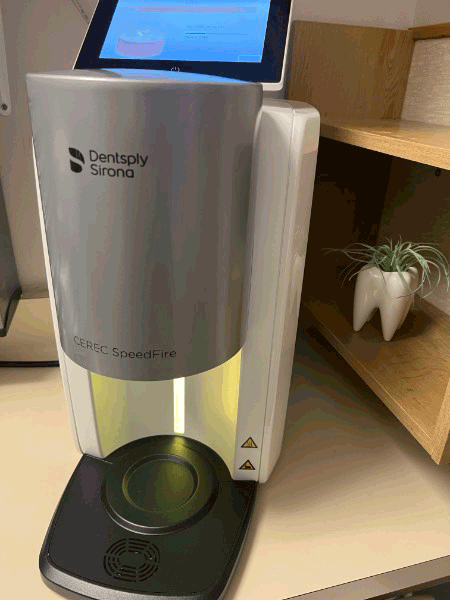
If it has ever been suggested by your dentist, that your tooth may need a crown (cap) there are currently a myriad of materials and treatment options available to you. Your dentist may suggest a crown if the tooth in question has broken, is severely decayed, has been previously treated with a root canal, or possibly for aesthetic reasons. One of the most recent technological advances in dentistry, called CEREC, has vastly improved the entire process of crown restoration.
The traditional process for restoring a tooth with a crown involves at least two separate visits to the dental office. Initially the tooth is prepared by first removing any decay and or weak structure. Second the tooth is shaped in a fashion to accommodate the final crown. Next an impression or a mold of the area is taken utilizing trays filled with dental putty. The tooth is then temporarily covered with an approximately sized interim/ temporary crown and the impression is boxed and shipped to a dental laboratory. Typically, the laboratory requires about two weeks to make the final crown. Once it is returned to the dental office an appointment is needed to remove the temporary crown, try out and adjust the permanent crown and cement the final restoration.
CEREC technology has streamlined this entire process and now most crowns and even some bridges (several crowns connected in a series) can be entirely completed in a single visit. Utilizing a slightly modified technique, the tooth/ teeth are shaped to accommodate the crown. Next unlike the traditional method, the area is simply scanned by a camera and this information is uploaded to a computer. Additionally, because the crown is fabricated onsite there is no need to fabricate or wear a temporary crown. The data collected by the computer is organized and designed into a custom crown which is superb quality duplicated by an in-office CNC milling unit. The actual fabrication only takes about 30 minutes at which time the ceramic crown is ready for try-in and cementation.
Less missed work/ school, fewer injections, improved comfort, greater accuracy, The patient no longer has to tolerate the mess and/ or gag reflex stimulated by dental impression putty, and all completed in a single visit…amazing.
Ask West Bend Dental Center for more information on CEREC and see if you may be a good candidate for the wonderful dental advancement. Keep Smiling.